
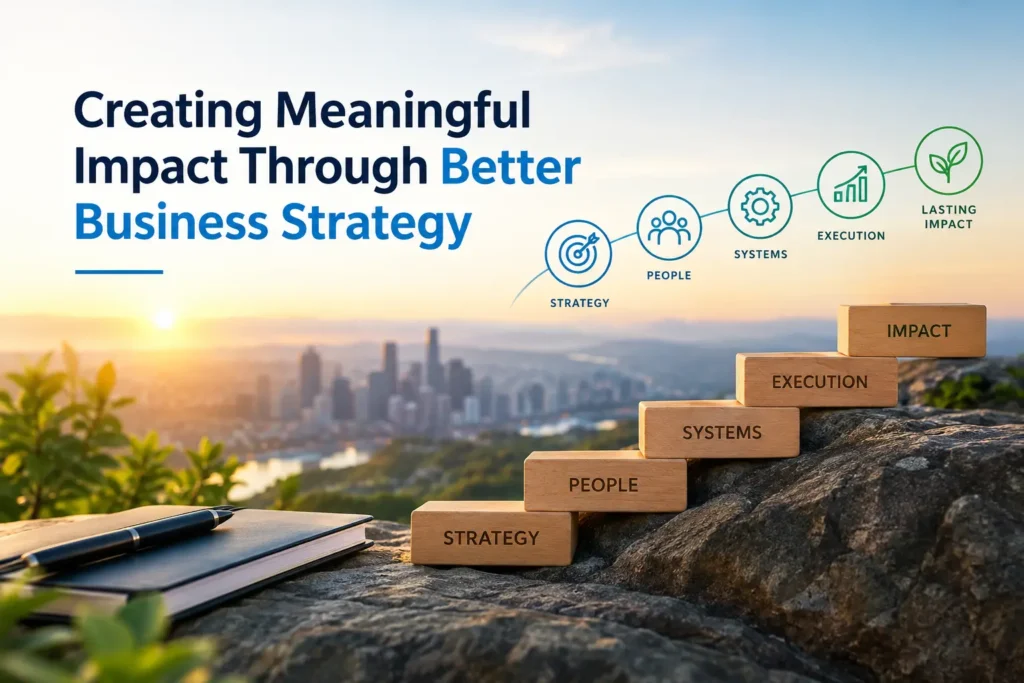
n today’s competitive business environment, success requires more than simply having a good product or service. Organizations need a clear direction, strong leadership, effective systems, and the ability to turn ideas into measurable results.
VP Impact is built around the idea that meaningful business impact comes from combining strategy, people, execution, and continuous improvement.
What Does Business Impact Really Mean?
Business impact is not simply about generating revenue. While financial performance is important, sustainable success also involves creating stronger organizations, improving operations, developing people, and building systems that can support long-term growth.
A business creates greater impact when its leaders understand where the organization is today, where it wants to go, and what needs to happen to close the gap.
This requires asking important questions:
- What are the organization’s most important goals?
- Are current systems supporting growth?
- Are employees equipped to perform effectively?
- Are leaders focused on the right priorities?
- How can the organization improve its results over time?
Answering these questions provides a foundation for meaningful business improvement.
Turning Strategy Into Action
One of the biggest challenges businesses face is the gap between planning and execution.
A company may have an excellent strategy, but if the strategy is not translated into clear actions, responsibilities, processes, and measurable objectives, it can remain nothing more than an idea.
Effective execution requires:
- Clear objectives – Everyone should understand what the organization is trying to accomplish.
- Defined responsibilities – People need to know what they own and what is expected of them.
- Effective systems – Repeatable processes help organizations operate consistently.
- Measurement – Key performance indicators help leaders understand whether progress is being made.
- Continuous improvement – Businesses need to evaluate results and adjust when necessary.
When these elements work together, strategy becomes an operating system for the organization rather than simply a document.
Developing People to Strengthen Organizations
People are one of the most important drivers of organizational performance.
Strong businesses do not simply hire people and expect them to succeed. They create environments where employees can understand expectations, develop their skills, take responsibility, and contribute to larger organizational goals.
Leadership development can help organizations build stronger teams by focusing on communication, accountability, decision-making, collaboration, and continuous learning.
When people understand how their individual responsibilities contribute to the organization’s objectives, their work becomes more purposeful and aligned.
Building Systems That Support Growth
Growth can expose weaknesses that were not obvious when a business was smaller.
Processes that worked for a small organization may become inefficient as the company adds employees, customers, products, locations, or responsibilities.
This is why business systems matter.
Well-designed systems can help organizations:
- Improve consistency
- Reduce unnecessary delays
- Clarify responsibilities
- Improve customer experiences
- Make training easier
- Reduce dependence on individual employees
- Support expansion
- Create greater operational visibility
The goal is not to create unnecessary bureaucracy. The goal is to create practical systems that allow people to perform their work effectively and allow leaders to focus on higher-value decisions.
Measuring What Matters
Improvement becomes difficult when there is no way to measure progress.
Businesses should identify the metrics that matter most to their specific objectives. Depending on the organization, these may include revenue growth, customer retention, employee performance, operational efficiency, profitability, customer satisfaction, or other key indicators.
Measurement provides leaders with information they can use to identify opportunities and make better-informed decisions.
The important question is not simply, “What are our numbers?”
It is:
“What are our numbers telling us about the business?”
Creating Long-Term Impact
Sustainable business success rarely comes from one major decision. It is usually the result of many improvements made consistently over time.
Organizations that want to create lasting impact should continually evaluate their strategy, people, systems, and results.
This creates a cycle of improvement:
Assess → Plan → Execute → Measure → Improve
By following this process, organizations can become more intentional about growth and better prepared to respond to changing market conditions.
The Importance of Purpose and Direction
Businesses need more than activity. They need direction.
When leadership has a clear understanding of the organization’s purpose and priorities, it becomes easier to determine which opportunities deserve attention and which activities are distractions.
A clear direction also helps employees understand why their work matters.
Ultimately, meaningful impact comes from connecting purpose with strategy, strategy with execution, and execution with measurable results.
Conclusion
Creating business impact requires a comprehensive approach. It involves understanding the organization’s current position, establishing clear objectives, developing capable people, improving systems, measuring performance, and continually looking for opportunities to improve.
Whether an organization is trying to strengthen its operations, develop its people, improve leadership, or prepare for growth, the underlying principle remains the same:
Better results begin with better decisions, better systems, and better execution.
Organizations that commit to continuous improvement can create stronger foundations for sustainable growth and meaningful long-term impact.
Frequently Asked Questions
What is business impact?
Business impact refers to the measurable and meaningful results an organization creates through its strategy, operations, people, products, and services.
Why is business strategy important?
A clear business strategy provides direction and helps an organization prioritize resources, establish objectives, and coordinate its actions toward specific outcomes.
How can businesses improve their performance?
Businesses can improve performance by evaluating their current operations, establishing measurable goals, developing employees, improving systems, monitoring key metrics, and continuously refining their approach.
Why are business systems important for growth?
Effective systems create consistency, clarify responsibilities, improve efficiency, and help organizations handle increasing complexity as they grow.
How can leadership contribute to organizational success?
Effective leadership provides direction, establishes expectations, develops people, encourages accountability, and helps align individual efforts with organizational objectives.